Itchy Scalp
Itchy scalp presents a variety of symptoms including irritation, redness, a flaky scalp, crusty scalp, excessive oil and a dry scalp. Furthermore these symptoms may lead to hair loss. Most noteworthy, this may indicate a simple or a more sinister flaky scalp condition. So what will you do next? This depends on how you are being affected and what you are currently doing to treat your dry scalp.
The GP is of course a point of contact as well as a local Pharmacy who may be able to assist you. However, if this isn’t offering a solution then you may want to seek alternative, professional advice from a trichologist. At the Holborn Clinic we advise and treat most crusty scalp issues. Email any questions you have by filing in the contact form. Alternatively, arrange a telephone consultation free of charge with a trichologist. Alternatively, arrange a consultation in person.
Causes of Itchy Scalp
An Itchy scalp can be a symptom of: poor hygiene, inadequate rinsing, Scalp Eczema, Scalp Psoriasis, Dandruff, Seborrhoeic Dermatitis (aka the various forms of Pityriasis – Pityriasis Simplex Capitis, Pityriasis Rotunda, Pityriasis Circinata), Pediculus Capitis & Irritant or allergic reactions. Many of which are chronic conditions that may be controlled. Some itchy scalp conditions may be removed with treatment.
Hair loss in some cases may present itself when an flaky scalp is present. If the crusty scalp is under stress through disease, the hair follicles may go into a resting state, which fails to produce hairs. Once the dry scalp has been treated the hair growth may return to that of the norm.
Free Telephone Consultation
Our Clinic offers a free telephone consultation service. You can ring and have a chat with a qualified trichologist (hair doctor). The idea is to assess the condition give you advise on the best method of dealing with your flaky scalp. Scalp complaints can be simple or perhaps more sinister. A phone call will enable us judge the severity an advise you accordingly. Perhaps write down a few questions to ask us. We are here to help you so what are you waiting for? Hope to speak to you soon. Thank you.
Consultation Holborn Clinic
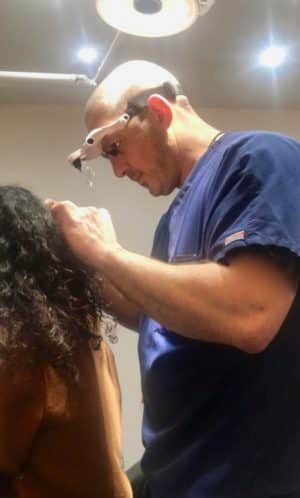
You may wish to sort a consultation at the clinic to discuss a flaky scalp condition. During the consultation we examine the dry scalp using microscopes if needed and establish a diagnosis. In addition we will discuss your medical status and explain in full what is causing the crusty scalp. As part of the consultation we may advise that treatment is appropriate. We fully explain the process and you will see the results. Treatment is of course optional.
If you would like to schedule a consultation at the Holborn Clinic with a TTS Trichologist then either ring us or complete the contact form just above. Don’t forget you can have a free consultation on the phone with a trichologist first. Thank you.
Advisory only
The Holborn Clinic team help many patients to deal with their itchy scalp at home. Removing certain products in your daily routine will suffice. Potentially, washing routines may be changed along with technique. Some shampoos that are apparently designed for itchy scalps can exacerbate the condition because they are often harsh on the skin. Give Us a call and speak with an expert now!.
Home care
An itchy scalp can be dealt with at home in some cases. The correct professional advice should be sought first. We have products that deal with a range of itchy dry scalp conditions. We may be able to advise on the phone what to use but in most cases we would need to see you in person to confirm a diagnosis. Our products are only available to purchase after speaking to a qualified trichologist.
Itchy Scalp Treatment at the Holborn Clinic
We would need to see you in person to advise and treat the more serious or chronic itchy scalp conditions. Itchy scalps tend to cause the skin to proliferate at a greater speed hence the treatment involved slowing this process. It is the accelerated growth rate that caused the flaky scalp and the itching along with other factors. Treating the itchy scalp involves removing the crusting and calming the underlying skin, slowing the cell growth and removing the itch. Please note that removing the crust is a specialist skill that should not be attempted at home.
Relief
We can offer relief from irritation and remove much of the crusty flaky skin. In the majority of cases we are able to control or in certain conditions remove (chronic or acute) scalp conditions within a relatively short space of time with limited cost to the patient. Please contact our help line to find out about out treatment techniques and what we can do for you. In many cases we are able to offer some home care solutions to aid recovery after consultation.
Pityriasis Amiantacea
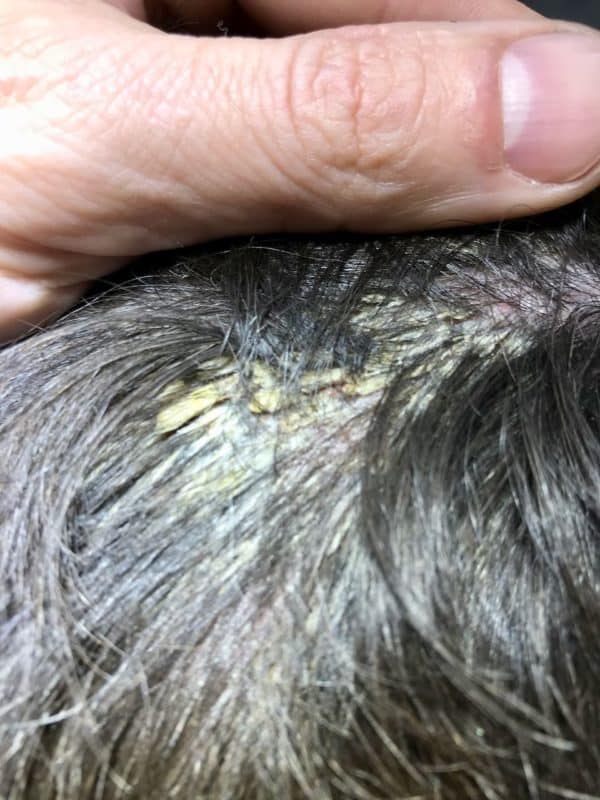
Presenting symptoms as thick scales that grow up the hair shaft. The condition resembles asbestos hence the name (Amiante French word for asbestos). The left image shows before treatment. The right image shows treatment after one session at our clinic.
We deal with most flaky scalp conditions that affect the skin. Give us a call or email us and I am sure we can assist you. Thank you.
Poor Hygiene
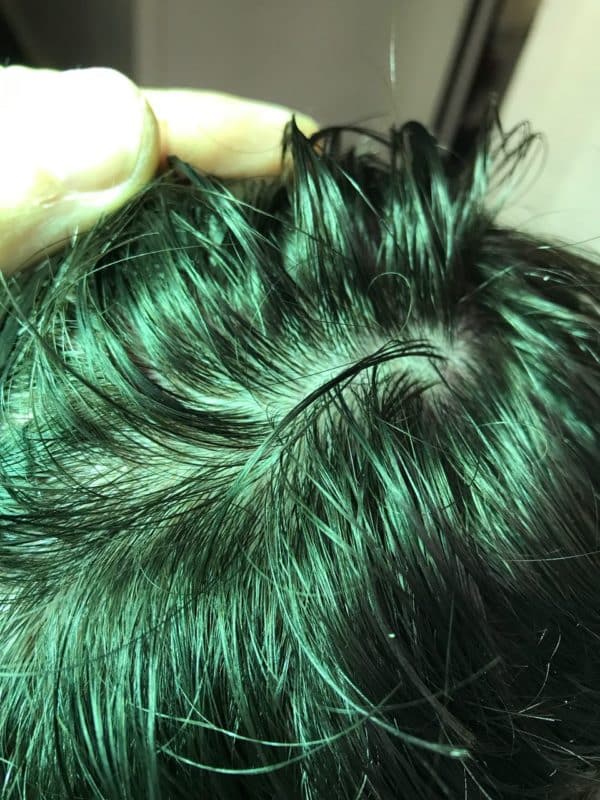
May lead to an itchy scalp and possible secondary infection. The scalp in all cases needs proper cleansing and should in most cases be washed at least twice a week. The application of oils and other such items to keep the scalp moist may well exacerbate the condition contrary to belief. If you are in any doubt please contact the help line and you can speak to a trichologist now.
Contact Reaction
Many patients suffer from an itchy inflamed scalp a result of a contact reaction. Often due to hair dye or styling products. A contact reaction may cause severe discomfort, pain, erythema and of course irritation. So you are well advised to always get a contact reaction checked out as hair loss may follow. Please note the hair loss will not happen immediately, it will occur months later.
Scalp Psoriasis
Psoriasis is a condition that affects the whole body. The scalp is a particular region that causes many people distress and unsightly legions. The skin thickens and sticks together forming a white or sometimes yellow scalp. The skin underneath is red and inflamed. Statistically 3% of the population are affected. Affects males and females alike. Psoriasis is not contagious. Genetic predisposition is common.
Dandruff
A popular collective name signifying a scaly flaking scalp condition. Pityriasis Simplex Capitis (pityriasis sicca) is the correct name for dandruff. Simple dandruff is non-inflammatory. It is the outer layer of the skin due to the presence of Pityrosporon Ovale that exfoliates thus producing the scales. Dandruff is common to both sexes and presents no affiliation to ethnic background or skin colour. Human skin cells are continually manufactured and shed. Clothing often assists in the shedding. Hairy skin may retain these exfoliated cells which join to form sticky scales. Pruritis (itchy scalp) may be severe in some cases of dandruff. Further information on Dandruff
Atopic Dermatitis
Atopic Dermatitis is a common condition in both adults and children albeit children are affected more. Both Men and women are affected equally. The Condition tends to start may be during infancy (first few months) Symptoms include Crusting, weeping, pruritic, erythema typically on the face, scalp and genital region. Further information on Atopic Dermatitis.
You may be an atopic type which means that you are susceptible to hay fever, allergens and skin ailments. If you are suffering from any skin condition you should seek professional advice. There are many companies selling wonder potions and cures which are expensive and may cause the condition to worsen.
Scalp eczema
Often causing an itchy scaly scalp. Scalp eczema is a non contagious chronic or acute itchy scalp conditions. Symptoms include: oozing and weeping, erythema (inflammation), skin thickening, presences of papules and vesicles (blisters).
Pruritis (itchy burning scalp, sometimes severe) leads to excoriation and possible bleeding. Affects all ages. Secondary infection may be present. Scalp eczema though not curable can often be successfully managed. Affected skin is susceptible to flare ups. Scalp Eczema is categorised into environmental and internal. You may find further information on scalp eczema here!
Skin Cancer
First of all skin cancer affecting the scalp is fairly uncommon. However, there are certain factors that may make you more susceptible. First of all a genetic predisposition and exposure to the sun are the main reasons. Here are the main forms of skin cancer. Most importantly do not under any circumstances use this as a guide to self diagnosis. Go and see a specialist right away. An itchy scalp maybe nothing to worry about, but as you will find out here it could be life threatening.
3 Main Skin Cancers
Basal Cell Carcinoma (BCC)
First of all this type of skin cancer affects the basal cells of the Epidermis. Therefore we are discussing the outer layer of the skin. Basal Cell Carcinoma is very common. Did you know that around 75% of all skin cancers are this type. Most noteworthy, this form of skin cancer tends not to spread to other parts of the body and is very slow in its progression. Most importantly, with treatment you are likely to be cured.
However, there are some skin cancers that are aggressive and spread to the dermis, sub dermis and bones making treatment difficult. Recurrence is a possibility and like any form of cancer maybe life threatening. Evidently, the symptoms vary. Maybe a pink spot that may be raised or flat. Also bleeding is easy even with a small injury. Furthermore large cancers, can be crusty (like Psoriasis) and shiny. There maybe a visible blood vessel on the surface.
Squamous cell carcinoma (SCC)
Squamous Cell Carcinoma aka SCC is a slow growing form of skin cancer that affects the out layers of the skin. Also being the second most common form. Most importantly, treatment will cure this in most cases. Also if left untreated there is a risk of spreading to other parts of the body. However, it can be aggressive is a small amount of cases and spread early. Squamous Cell Carcinoma starts with a scaly patch which feels rough. Also within a short period of time will become red, raised and firm. You may find the skin feels tender to the touch too.
Malignant melanoma
First of all this a malignant Melanoma acts differently to that of other skin cancer. Also it is much more aggressive and a very dangerous life threatening type of skin cancer. Most importantly treatment must be quickly administered. Furthermore the appearance varies. It will probably show as a brown or black spot with a darker boarder. A helpful thing to look out for is the appearance of a dark mole that changes. Also a malignant Melanoma can show as a firm pink or red lump.
There are four main types of skin melanoma:
Superficial spreading melanoma
Considered the most common form. Also more likely to affect the legs, chest, arms and back. Most noteworthy the growth is slow to start after which it spreads.
Nodular melanoma
Slightly less common that the Superficial Spreading Melanoma. Nodular Melanomas can grow the quickest when discussing Melanomas. Furthermore it tends to affect the head or neck and the back. Most noteworthy it tends to loose its colour when growing becoming red not black. This can be confusing and give the assumption that the skin is getting better. Be warned!
Lentigo maligna melanoma
Older people who have been exposed to the sun over a prolonged period of time, are more likely to be affected and this form is less common. Also this develops from a precancerous condition known as Lentigo Maligna aka a Hutchinsons Freckle. The skin will look like it is stained. Also this form is not as dangerous as other forms of melanoma.
Acral lentiginous melanoma
Tends to affect afro and darker skin types and is also not related to sun exposure. Furthermore this is the rarest form affecting the palms of hands, soles of feet and under our nails.
Another rare type of melanoma is desmoplastic melanoma. Furthermore Melanomas in some cases can start away from the skin. Maybe the eyes (Ocular Melanoma). Or maybe the inner linings of the anus, rectum, mouth, lungs and nose etc.
Rare types non-melanoma skin cancer
There are some other rare types of skin cancer that account for approx. 1% of all skin cancers in the UK
Merkel cell carcinoma
Kaposi’s sarcoma
Cutaneous T-cell lymphoma of the skin
Sarcoma.
Finally, if you have a thought, an idea, or even a guess that you may have skin cancer then go and get it checked out. The chances are it’s nothing. Furthermore, it won’t go away if you forget about it. This could be life threatening. You can give us a ring if you wish but I will say this that a dermatologist is the right person to seek advice from. There will probably be a need for a biopsy or other form of testing. Please don’t waste anymore time.
The NHS helpline is another point of contact for skin Cancer
Call 111 which is a 24 hour helpline for the NHS in cases where you feel there is sense of urgency.
There are numerous other diseases and ailments that affect the skin. The information above has only touched the surface. Some conditions are more sinister and present a multitude of symptoms. The itchy scalp may only seem a minor issue but an itchy scalp an be a symptom of skin cancer. Whoever you choose to see I would in all cases seek professional advice.
If you had a rash on your face that just appeared and remained, would you leave it or go and find help?
Common Myths Itchy Scalp
Many patients that attend the clinic for an Itchy scalp condition tell me they use “natural oil” such as coconut and t-tree oil because it keeps the scalp moist therefore solving the itchy scalp problem. It is because of the oil that in many cases the skin continues to have an itchy scalp. The application of oil will in some cases assist to remove the crusting that often goes along side an itchy scalp therefore masking the problem. The continuing use of oil on the scalp may well lead to complications such as dryness. Yes it can dry out the skin. Think of what happens when you have your hands in washing up solution?
Your hands are dry and need some moisture right? Well the application of oil that remains on the scalp may well have the same effect therefore the skin has a masking agent (the oil) covering the head.
My advice on an Itchy Scalp
Do not to apply oil on the scalp and leave it for days and potentially weeks without removing it. Your scalp needs to be free of any products, lotions, potions and oil. The scalp needs to be able to at all times at its original state. Yes moisture is a good thing in some cases to assist the skin because some people have a scalp condition such as scalp eczema or Psoriasis that requires extra moisture. But it needs to be the right application.
Oily Scalp
Please be mindful that if you have an itchy scalp condition and are a person that uses oils on the scalp on a regular basis the sudden removal of oil will probably cause the skin the present a dry scalp because it is used to the oil. It would be in you best interest to contact a specialist for advice. You can give us a call and speak with a trichologist right now. Alternatively, you can have a read of the site and see if that helps.
Remember, if you have scalp ailment then there may be something that could cause hair shedding. A scalp that is uncomfortable may cause hair loss but not right away. It will happen several months later.
The Holborn Clinic registered Trichologists with the Trichological Society TTS and the Care Quality Commission CQC
Olive oil
Olive oil when warm may assist in softening the crusty scalp therefore it can loosen the flaky skin on the surface. The patient should warm the oil, rub in your hands and apply to the flaky scalp by massaging in. The oils should be left for several hours or over night therefore giving the dry scalp amply time to release the crusting.
This is a common method used today because it will help remove the crusty scalp excess skin. Most importantly you should make sure that all the oil is removed after treatment. You should be aware that oils can make an itchy scalp worse if used in the wrong circumstance. Everyone is different and we will react in varying ways when oil is applied to the a crusty scalp. Establish a diagnosis first before attempting any form of home care. Feel free to call the clinic for advice.
Oatmeal Colloidal
Colloidal Oatmeal is found in some crusty scalp treatments. Colloidal oatmeal is a natural ingredient dissolved in water. The application forms a film on the dry scalp which locks in the moisture therefore keeping the skin wet. This can assist in removing the unwanted flaky scalp skin and can help in reducing the itchy scalp.
Colloidal Oatmeal is well known as an anti-inflammatory and holds antioxidant properties which may help an itchy scalp. Most importantly, like the oil, the skin can react to such applications in a negative way therefore you should always establish a diagnosis prior to attempting home care remedies.
Apple cider vinegar
Containing a natural substance known as acetic acid, apple cider vinegar is used as a wound treatment as it holds antibacterial and antifungal properties. Furthermore it is used to help a crusty scalp condition. Advice should be sought prior to attempting such a crusty scalp treatment.
Psoriasis sufferers use this to assist in relieving the itch. The national Psoriasis Foundation suggest that diluting the apple cider vinegar in water to a ratio of 1 and 1 (1 part vinegar and one water), apply to the crusty scalp and wait until dry or rinse after a few minutes.
Apple cider vinegar should be used with care as applying to cracks or wounds causes burning. In fact, this treatment can cause severe chemical burns therefore you should seek professional advice when using such a remedy.
Peppermint oil
Peppermint oil can assist in relieving an itchy scalp. It contains high levels of a natural ingredient called menthol. The application of peppermint oil on the dry scalp may offer a cooling effect which call assist in relieving the irritation caused by allergens.
Peppermint oils should not be used on a crusty scalp in its neat form. It should be diluted. This form of treatment is often used by applying a few drops in shampoo. Be warned, applying anything to a shampoo could cause a chemical reaction which could cause damage to the skin. Before using such a remedy you should seek professional advice.
Lemongrass oil
Lemongrass oil is another perhaps lesser known remedy used to assist in the treatment of dandruff and the itchy scalp. Trials have established that this in some cases has been effective. The effectiveness of any treatment on a crusty scalp depends on the recepients skin and how it reacts. Care should be used in applying any such treatments to the dry scalp because a skin reaction may occur therefore professional advice when treating itchy scalp is advisable.
Tea tree oil & nerolidol
Tea tree oil is often used as a treatment for head lice. Studies have shown that headlice don’t like tea tree oil and the application of tea tree oil can kill headlice. In addition the diluted application on the affected dry scalp can help prevent the spread. My daughters both have used tea tree oil on a daily basis and have never suffered from headlice.
Nerlidol is a natural substance found in plants. This is another remediy for headlice. Deemed less effective that tea tree oil therefore used less.
Salicylic acid
Salicylic acid is a natural chemical found in plants. Holding excellent anti-inflammatory and antibacterial properties, this is commonly used in the treatment of itchy scalp conditions. Salicylic acid assists in exfoliating the crusty scalp therefore a good treatment for the itchy scalp.
Selenium sulphide
Selenium sulphide often found in crusty scalp shampoos works by slowing the rate of cell growth therefore if can prevent the build up of flaky skin. It can have an effect on reducing the yeast found on the scalp which often contributes to dandruff and other skin ailments causing the itchy scalp. Selenium Sulphide can discolour the skin. Care should be taken when using any home care products and a correct diagnosis should be sought in the first instance.
Afro Itchy Scalp
The Afro Scalp is susceptible to an itchy scalp like that if other skin types. Make sure you keep the scalp clean and void of chemicals. Furthermore the use of black hair products can contribute to flaky scalp conditions.Correct Afro Scalp Cleaning should be adopted. Afro Scalps suffer more from itchy scalps due to the lack of cleansing. I appreciate that afro hair is weaker and tends to break easier. This is the reason why it is common practice not to wash too often.
Afro Scalp Cleansing
You must keep the scalp. The hair itself doesn’t need to be washed. The Rinsing the hair alone is sufficient. This about it, would you leave your face for a week without washing it? Have a look at the afro scalp page or the afro scalp cleansing page for more information.
Afro Hair loss is often caused by a flaky scalp condition. If the skin is unhappy then hair loss may well follow. Hair loss can be slight and not noted. It can also be extensive. If you are suffering from a a skin condition please get it looked at and don’t try and self diagnose. It may well be that you are suffering from a minor skin issue that is early dealt with. It may be the symptoms of a more sinister hair loss condition. Have a look at our page on Afro Hair loss which may assist you. Other hair loss conditions include Telogen effluvium, Hair shaft defects, Alopecia Areata, traction alopecia, atopic dermatitis etc. There are many others which are listed above in the menu.
Frequently asked Itchy scalp Questions:
Question
Can I dye my hair with a dry scalp because I want to?
Answer
Do not dye your hair. The skin is unhappy at present because of a skin ailment. Find out what is causing the problem first before thinking of colouring your hair. Test your hair each time. Test the skin as well. Think about it. It might be the hair dye that is causing the problem.
Question
I am losing my hair at the moment. Will it all go? I have an itchy scalp.
Answer
Go and see a trichologist. You are loosing hair and this may well continue until you establish a cause. You need to establish what is happening first. Finally, The hair is unlikely to all go but it could shed considerably.
Question
I am about to buy some scalp cream of the internet. Oh and I have head and shoulders shampoo. Will that help?
Answer
You are buying scalp cream? What condition do you have? What is in the scalp cream? Is this from your Doctor or pharmacist? Using scalp cream without knowing what you have is wrong. Be diagnose first. Then take advice on what to use. Head and shoulders is a good shampoo to assist with dandruff.
Question
First of all I am Black. Furthermore I have seen two trichologists before. One sold me a shampoo. It seems like this has made it worse. It’s hair loss in patches and a flaky scalp.
Answer
It seems like you have been given the wrong treatment. Above all you don’t have a diagnosis. First of all, how long has this been affecting you? How large are the patches? Have you had any blood tests? Similarly, is the skin red? inflamed? Rather than me attempt to give you an answer, I would ask you ring me as soon as you can to discuss your ailment. I must see the scalp which can be done via Skype or email. Above all, i want to see the severity and how it is affecting you.